Microsoft
Microsoft AZ-700
Designing and Implementing Microsoft Azure Networking Solutions
Practice questions with verified answers, detailed explanations, and community discussions.
- 287
- Questions
- today
- Last updated
- 25
- Free questions
Question 21 of 287
Topic 1: Design, implement, and manage connectivity servicesTopic 1: Design, implement, and manage connectivity services
HOTSPOT
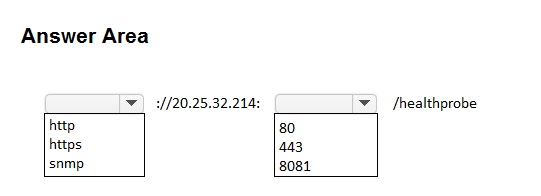
You have an Azure subscription that contains a virtual network gateway named VNetGwy1. VNetGwy1 has a public IP address of 20.25.32.214.
You need to query the health probe of VNetGwy1.
How should you complete the URI? To answer, select the appropriate options in the answer area.
NOTE: Each correct selection is worth one point.
Question 22 of 287
Topic 1: Design, implement, and manage connectivity servicesTopic 1: Design, implement, and manage connectivity services
HOTSPOT
You have an on-premises datacenter.
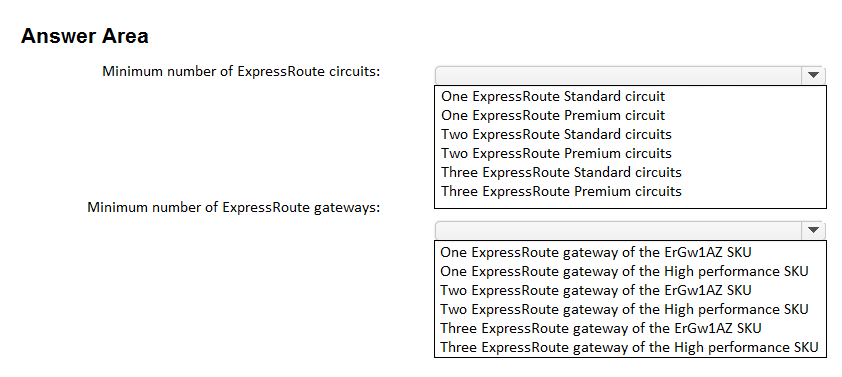
You have an Azure subscription that contains 10 virtual machines and a virtual network named VNet1 in the East US Azure region. The virtual machines are connected to VNet1 and replicate across three availability zones.
You need to connect the datacenter to VNet1 by using ExpressRoute. The solution must meet the following requirements:
• Maintain connectivity to the virtual machines if two availability zones fail.
• Support 1000-Mbps connections.
• Minimize costs.
What should you include in the solution? To answer, select the appropriate options in the answer area.
NOTE: Each correct selection is worth one point.
Question 23 of 287
Topic 1: Design, implement, and manage connectivity servicesTopic 1: Design, implement, and manage connectivity services
You have an Azure subscription that contains a virtual network named VNet1 and the virtual machines shown in the following table.
All the virtual machines are connected to Vnet1.
You need to ensure that the applications hosted on the virtual machines can be accessed from the internet. The solution must ensure that the virtual machines share a single public IP address.
What should you use?

Choose your answer
Pick an answer to check it, or press Show answer to see the correct one.
Question 24 of 287
Topic 1: Design, implement, and manage connectivity servicesTopic 1: Design, implement, and manage connectivity services
Case Study
This is a case study. Case studies are not timed separately. You can use as much exam time as you would like to complete each case. However, there may be additional case studies and sections on this exam. You must manage your time to ensure that you are able to complete all questions included on this exam in the time provided.
To answer the questions included in a case study, you will need to reference information that is provided in the case study. Case studies might contain exhibits and other resources that provide more information about the scenario that is described in the case study. Each question is independent of the other questions in this case study.
At the end of this case study, a review screen will appear. This screen allows you to review your answers and to make changes before you move to the next section of the exam. After you begin a new section, you cannot return to this section.
To start the case study
To display the first question in this case study, click the Next button. Use the buttons in the left pane to explore the content of the case study before you answer the questions. Clicking these buttons displays information such as business requirements, existing environment, and problem statements. When you are ready to answer a question, click the Question button to return to the question.
Overview
Litware, Inc. is a financial company that has a main datacenter in Boston and 20 branch offices across the United States. Users have Android, iOS, and Windows 10 devices.
Existing Environment
Hybrid Environment
The on-premises network contains an Active Directory forest named litwareinc.com that syncs to an Azure Active Directory (Azure AD) tenant named litwareinc.com by using Azure AD Connect.
All offices connect to a virtual network named Vnet1 by using a Site-to-Site VPN connection.
Azure Environment
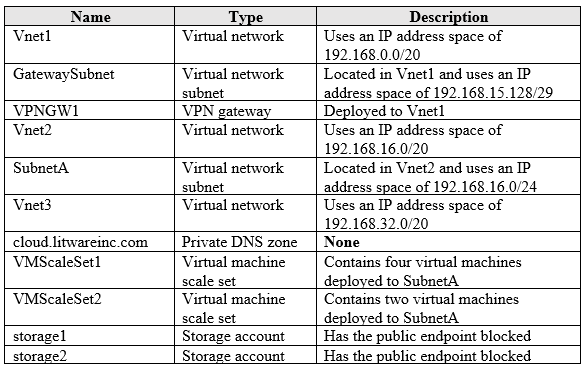
Litware has an Azure subscription named Sub1 that is linked to the litwareinc.com Azure AD tenant. Sub1 contains resources in the East US Azure region as shown in the following table.
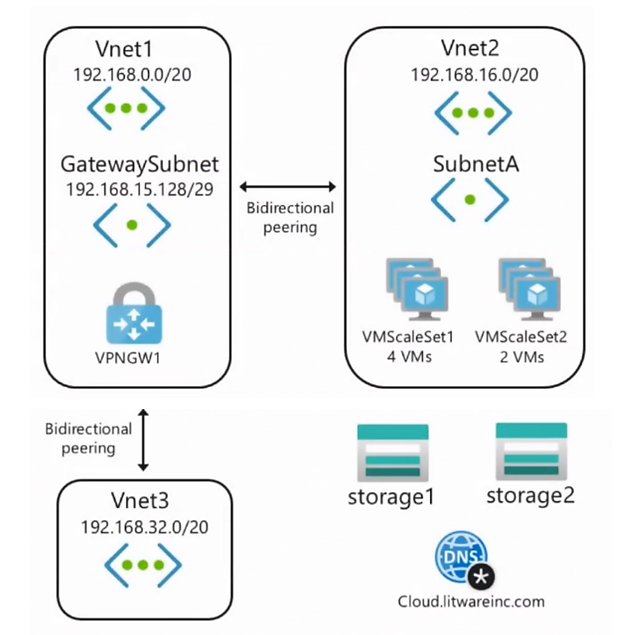
A diagram of the resource in the East US Azure region is shown in the Azure Network Diagram exhibit.
There is bidirectional peering between Vnet1 and Vnet2. There is bidirectional peering between Vnet1 and Vnet3. Currently, Vnet2 and Vnet3 cannot communicate directly.
Azure Network Diagram
Requirements
Business Requirements
Litware wants to minimize costs whenever possible, as long as all other requirements are met.
Virtual Networking Requirements
Litware identifies the following virtual networking requirements:
• Direct the default route of 0.0.0.0/0 on Vnet2 and Vnet3 to the Boston datacenter over an ExpressRoute circuit.
• Ensure that the records in the cloud.litwareinc.com can be resolved from the on-premises locations.
• Automatically register the DNS names of Azure virtual machines to the cloud.litwareinc.com zone.
• Minimize the size of the subnets allocated to platform-managed services.
• Allow traffic from VMScaleSet1 to VMScaleSet2 on the TCP port 443 only.
Hybrid Networking Requirements
Litware identifies the following hybrid networking requirements:
• Users must be able to connect to Vnet1 by using a Point-to-Site (P2S) VPN when working remotely. Connections must be authenticated by Azure AD.
• Latency of the traffic between the Boston datacenter and all the virtual networks must be minimized.
• The Boston datacenter must connect to the Azure virtual networks by using an ExpressRoute FastPath connection.
• Traffic between Vnet2 and Vnet3 must be routed through Vnet1.
PaaS Networking Requirements
Litware identifies the following networking requirements for platform as a service (PaaS):
• The storage1 account must be accessible from all on-premises locations without exposing the public endpoint of storage1.
• The storage2 account must be accessible from Vnet2 and Vnet3 without exposing the public endpoint of storage2.
You need to connect Vnet2 and Vnet3. The solution must meet the virtual networking requirements and the business requirements.
Which two actions should you include in the solution? Each correct answer presents part of the solution.
NOTE: Each correct selection is worth one point.
Choose your answer
Pick an answer to check it, or press Show answer to see the correct one.
Question 25 of 287
Topic 1: Design, implement, and manage connectivity servicesTopic 1: Design, implement, and manage connectivity services
HOTSPOT
You have an Azure subscription.
You plan to use Azure Virtual WAN.
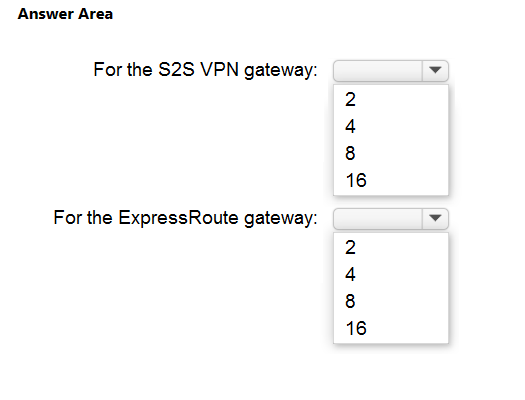
You need to deploy a virtual WAN hub that meets the following requirements:
• Supports 4 Gbps of Site-to-Site (S2S) VPN traffic
• Supports 8 Gbps of ExpressRoute traffic
• Minimizes costs
How many scale units should you configure? To answer, select the appropriate options in the answer area.
NOTE: Each correct selection is worth one point.
262 questions still locked
The free preview covers the first 25 questions. Unlock the rest to see every question with its answer and explanation.
Full access
$19.99USD
3 months of access · one-time payment, no subscription
- Every question in this exam unlocked
- Answers with detailed explanations
- Download all questions as a PDF
- Works on phone, tablet and desktop
- Pass guarantee: refund if you don't pass
Secure payment powered by Stripe. By buying you agree to our Terms and Refund policy.
Already have an account? Log in